
Indian stock markets have experienced some ups and downs in the first half of 2025. However, both the Nifty 50 and Sensex saw steady gains, supported by a healthy economy and better corporate earnings. In this article, we will look at the detailed performance of these key indices and explore the sectors that drove the market rally.

Comparative to other Asian GDP growths, India would have the fastest economic expansion, it said

GVA growth in the manufacturing, farm and construction sectors tumbled.

From the 30-share blue-chip pack, Adani Ports, UltraTech Cement, Larsen & Toubro, Sun Pharma, HDFC Bank, ICICI Bank, NTPC and State Bank of India were the major laggards. Tata Consultancy Services, Reliance Industries, ITC, Asian Paints, HCL Tech and Maruti were among the gainers.

A year after the RG Kar rape-murder Swarupa Dutt/Rediff look at the city where it happened, Kolkata -- its study in dichotomy, at once the self-proclaimed cultural capital of India as also a petri dish for a peculiar rage that breeds crimes against women.

Prime Minister Narendra Modi has emphasized dialogue over discord in India's relationship with China, acknowledging natural differences between the two countries but stressing that stronger cooperation is essential for their mutual interests and global stability. In a podcast with Lex Fridman, Modi highlighted the ongoing efforts to restore normalcy along the border following the 2020 clashes, emphasizing the importance of a stable and cooperative relationship.

India's GDP growth will be 7.5% this year: Jaitley

The Indian economy is projected to grow at 6.2 per cent in 2025-26, slower than earlier estimated rate of 6.5 per cent, due to escalated trade tensions and global uncertainty, the International Monetary Fund (IMF) said on Tuesday. "For India, the growth outlook is relatively more stable at 6.2 per cent in 2025, supported by private consumption, particularly in rural areas," IMF said in its World Economic Outlook (WEO).

Dominic Xavier asks if it is right to blame coronavirus and the lockdown for India's economic decline.

Morgan Stanley believes that the factors responsible for the weak GDP growth include poor agricultural growth, weak investment trend, sluggish domestic market growth outlook and weakness in the service sector.

Equity investors would track global market trends, inflation data and trading activity of foreign investors for further cues this week, analysts said. Moreover, progress of monsoon and developments related to trade talks would also be monitored by investors, experts noted.
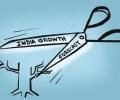
Fitch Ratings on Thursday slashed India's GDP growth projection for FY23 to 7 per cent, saying the economy is expected to slow against the backdrop of global economy, elevated inflation and high interest rate. In June, it had forecast 7.8 per cent growth for India. "We expect the economy to slow given the global economic backdrop, elevated inflation and tighter monetary policy. "We now expect the economy to grow 7 per cent in the financial year to end-March 2023 (FY23) from 7.8 per cent previously, with FY24 also slowing to 6.7 per cent from 7.4 per cent before," Fitch said in its September edition of the Global Economic Outlook.

India, whose economy has been coasting along at 8 per cent for the last three years, can achieve 9.5 per cent GDP growth even in the absence of hard labour reforms or foreign direct investment in the retail sector.

India's manufacturing sector growth fell to a 14-month low in February amid softer increase in new orders and production, a monthly survey said on Monday. The seasonally adjusted HSBC India Manufacturing Purchasing Managers' Index (PMI) registered 56.3 in February, down from 57.7 in January, but remained firmly within the 'expansionary' territory. In PMI parlance, a print above 50 means expansion, while a score below 50 denotes contraction.

India Inc's net profit as a percentage of the country's gross domestic product (GDP) is just shy of reaching 5 per cent, bolstered by strong earnings growth in the second quarter of 2023-24. Analysts interpret this as an indication that a corporate profit upcycle is in progress, with projections suggesting that this share could exceed 8 per cent within the next five years, driven by bullish earnings growth expectations. "We believe we are only halfway through a profit cycle, with the profit share in GDP rising from a low of 2 per cent in 2020 to about 5 per cent currently, and likely heading to 8 per cent in the coming four to five years. "This implies about 20 per cent compounding of earnings growth. "Underscoring this forecast is the start of a new private capex cycle, under-geared balance sheets, a healthy banking system, lower corporate tax rates, improving terms of trade, and structural consumption demand outlook albeit somewhat offset by likely consolidation in government deficit," said Ridham Desai, managing director, head of research, Morgan Stanley India in a note.

India's growth rate is expected to improve to 7 per cent by FY 2017, while inflation and current account deficit are likely to moderate in the coming years, a Citigroup report said.

'We face the risk of remaining a low-income country for a very long time unless something changes in the next few years.' 'Instead of constantly talking about becoming a developed economy, we need to start fixing the problems of the economy one by one.' 'There is so much potential, and we are squandering away the opportunity.'

The weakening of inflation, prospects of economic growth, geopolitical uncertainty and comfortable system liquidity may result in the Reserve Bank of India's (RBI) Monetary Policy Committee (MPC) to cut the repo rate by another 25 basis points, opine top economists. They also said the external economic pressures like trade policies and others would require continued RBI's accommodative stance and policy support for the Indian industry to sustain the growth.

There is a need for real-time or near real-time credit reporting, instead of the current fortnightly system, to improve underwriting precision, enable timely reflection of borrower actions such as loan closures or repayments, and deliver a superior consumer experience, Deputy Governor of the Reserve Bank of India (RBI), M Rajeshwar Rao said on Wednesday.

The Centre's fiscal deficit touched 74.5 per cent of the annual target at the end of January 2025, according to the data released by Controller General of Accounts (CGA) on Friday.

The agriculture sector has witnessed feeble growth on account of drought for two successive years

The Interim Budget for 2024-25 (FY25) to be presented on February 1 is likely to assume 10-10.5 per cent nominal gross domestic product (GDP) growth against 8.9 per cent estimated for FY24 by the National Statistical Office (NSO). "We were waiting for the First Advance Estimates GDP numbers for FY24. "We will finalise the nominal GDP growth assumption for FY25 Interim Budget in a couple of days.
The real gross domestic product growth is likely to touch 9 per cent in 2003-04 based on better than expected performance of the agriculture sector, according to Centre for Monitoring Indian Economy.
The RBI-sponsored survey by professional forecasters has revised the growth projection for the current fiscal downward to 7 per cent, which is lower than the central bank's projection of 7.6 per cent.

Crisil Ratings on Wednesday projected India's GDP growth at 6.8 per cent in the next fiscal and said the country will become an upper middle-income nation by 2031 with the economy doubling to $7 trillion. In its India Outlook report, Crisil said the Indian economy will take support from domestic structural reforms and cyclical levers and can retain -- perhaps even improve -- its growth prospects to become the third largest economy by 2031. "After a better-than-expected 7.6 per cent this fiscal, India's real GDP growth will likely moderate to 6.8 per cent in fiscal 2025," said the Crisil India Outlook report.

The southwest monsoon has arrived in Mumbai 16 days before its usual date, making it the earliest arrival since 1950. This early onset follows the monsoon's arrival in Kerala, the southernmost state, on Saturday, marking the earliest arrival since 2009. The India Meteorological Department (IMD) predicts an above-normal rainfall for the 2025 monsoon season, with rainfall between 96 per cent and 104 per cent of the 50-year average of 87 cm considered 'normal'. The monsoon is crucial for India's economy, providing vital water for agriculture and replenishing reservoirs.

The IMF's predictions for India's near-term growth may seem rosy, but the usual caveats apply - that is, we are apt to under-perform.

'Why has Maharashtra slipped up over the past couple of decades?' 'Not only is this question critical for residents of the state, but given that it accounts for 14% of India's GDP, a faster-growing Maharashtra implies a faster-growing India as well, point out Shishir Gupta and Rishita Sachdeva.

'...hesitate to support the risk-taking it requires.'

In a double-dose bid to boost growth and employment prospects, the Union Cabinet on Tuesday approved a Rs 2.07 trillion outlay for a research development and innovation (RDI) Scheme to fund private sector innovations, and an employment-linked incentive (ELI) to create over 35 million new jobs over the next two years.

The Trump trade shock is a chance to push long-overdue reforms, rather than tinker with tariffs to appease the US, suggests M Govinda Rao.

Finance Minister (FM) Nirmala Sitharaman has presented a forward-looking Budget, reinforcing the government's commitment to 'Reform, Perform, and Transform'.

She said it is even more important in the changing dynamic world where the business environment also keeps on changing all the time.
December's figure was the seventh successive quarter of economic growth below 5 per cent.

'The retail industry is still growing in double digits.'

"I feel no one can reject the contribution of Maharashtra and Marathi people in the history and present of the country. If someone is rejecting it, then I feel it is wrong," Fadnavis said.

India will need to grow at an average 7.8 per cent to become a high-income country by 2047, a World Bank report said on Friday. To achieve this goal India would require reforms in financial sector as well as in land and labour market, the World Bank said in its India Country Memorandum titled 'Becoming a High-Income Economy in a generation'.

The Budget should undertake further reductions in import tariffs and seriously consider an announcement of India's intention to join one or both of the two Asian mega-regional free trade agreements, suggests Shankar Acharya, former chief economic adviser to the Government of India.

India should convert the Trump threat to an India opportunity, re-embracing a more liberal trade regime as a way of reviving manufacturing output and exports.

Foreign investors continue to show confidence in the country's equity market, infusing Rs 14,167 crore so far this month, largely driven by favourable global cues and robust domestic fundamentals. Notably, this inflow has come despite the ongoing military tensions between India and Pakistan.
 © 2026 Rediff.com - Advertise with us - Disclaimer - Privacy Policy - Sitemap - Feedback - About us - Terms of use - Grievances